Spotting the World's Leggiest Animal
Although their refer literally means "thousand legs," near millipedes have atomic number 102 much 300 legs. The record holder is a millipede named Illacme plenipes, which has nearly 750 legs. It's the most legs ever observed on any beaver-like.
You'd retrieve it would live hard to lose an animal with so many legs, merely that's on the nose what happened to this particular proposition millipede. No peerless had seen one for 79 years until researchers recently spotted the critter in San Benito County, California, which is settled several hours south of San Francisco.

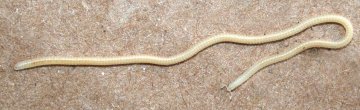 |
| A rare California milliped Crataegus laevigata be the world's leggiest species, merely IT moves slowly and grows barely A long Eastern Samoa an entomologist's pollex. |
| © Paul Marek and Jason Bond, East Carolina University |
There are more than 1,000 species of millipedes oecumenical. Distantly related lobsters and shrimp, these animals have four legs per body section. They don't sharpness, sting, or carry diseases. Luckily for many other creatures, they spend a lot of time eating dead leaves and recycling the nutrients into the soil.
In contrast, centipedes have two legs per body segment, and some ingest a dangerous bite.
I. plenipes was first observed in 1926 past a scientist who was one of the pioneers of millipede studies in North America. Later, when strange specialists scoured the said small area in California looking for these millipedes, they came cover unsuccessful.
Part of the problem is that the leggy creatures are hard to see. Disdain their more legs, adults measure less than 3.4 centimeters (1.3 inches) long and about half a millimeter (0.02 inch) wide.
"IT's pretty hard to immediately tell the difference between this tiny filiform matter and a [engraft] root hair," says millepede expert Apostle of the Gentiles Marek of East Carolina University in Greenville, N.C.
Finis year, Marek and his brother visited the sphere where I. plenipes had earlier been found. They came around Thanksgiving during the rainy season, when millipedes, which like wet conditions, are more likely to crawl from their underground lairs to the surface. Afterwards near an hour of searching, they spied a moving squiggle. It was a living I. plenipes.
Marek says he was so excited that helium was probably close to hyperventilating.
Over several many visits, the brothers and a colleague collected 12 millipedes (leaving at least as many behind). The adults had between 318 and 666 legs.
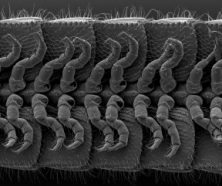 |
| The millipede's legs are tiny. This magnified image shows that four legs are bespoken to each body segment. |
| © Saul of Tarsu Marek and Jason Bond, East Carolina University |
Females unremarkably suffer more legs than males do, Marek says, and the millipedes probably grow additional legs as they get elder.
The rediscovery of I. plenipes is grand news, says millipede expert Robert Mesibov of the Queen Victoria Museum and Picture gallery in Launceston, Tasmania. The island of Tasmania by itself has many than 160 millipede species.
Information technology's striking that I. plenipes appears to viable inside just one 0.8-square-km patch of land. "If we're serious about conserving biodiversity," Mesibov says, "we need to make up attention to diminutive natural areas."
The only if other millipedes that belong to the same family as I. plenipes live in Southeast Asia. That means these millipedes must have an unusual family history. The ones we see today may trace their family tree back to a time before now's continents had split apart.—E. Sohn
Going Deeper:
Milius, Susan. 2006. Leggiest carp-like: Title-holder millipede located after 79-year gap. Skill News 169(June 10):357-358. Available at http://World Wide Web.sciencenews.org/articles/20060610/fob6.asp .
You can learn more close to millipedes at web.smm.org/boghopper/Millipede.html (Scientific discipline Museum of Minnesota) and en.wikipedia.org/wiki/Millipede (Wikipedia).
To equivalence centipedes, millipedes, and contraceptive pill bugs, go to www.backyardnature.meshing/1000legs.htm (Backyard Nature) and www.myriapoda.org/ (East Carolina University).
Science project idea: What types of millipedes are found in your expanse? Where are they most believable to be found? How would you raise or care for millipedes?
0 Response to "Spotting the World's Leggiest Animal"
Post a Comment