Va-jezzy Mel Rock - Im Back Again
| Run-DMC | |
|---|---|
 Run-DMC in a promotional shot. From left to correct: Jason Mizell, Darryl McDaniels, and Joseph Simmons. | |
| Background data | |
| Origin | Hollis, Queens, New York Urban center, NY, U.S. |
| Genres |
|
| Years active | 1983–2002[1] [ii] (occasional reunions since 2012) |
| Labels | Profile, Arista/BMG |
| Associated acts | Beastie Boys, Rick Rubin, Aerosmith, Jason Nevins, Kurtis Blow, Fatty Boys |
| Website | rundmc |
| By members | Joseph "Run" Simmons Darryl "D.One thousand.C." McDaniels Jason "Jam Master Jay" Mizell |
Run-DMC (likewise spelled Run-D.M.C.) was an American hip hop group from Hollis, Queens, New York City, founded in 1983 by Joseph Simmons, Darryl McDaniels, and Jason Mizell. Run-DMC is regarded as 1 of the most influential acts in the history of hip hop civilisation and ane of the virtually famous hip hop acts of the 1980s. Along with Beastie Boys, LL Cool J and Public Enemy, the grouping pioneered new schoolhouse hip hop music. The grouping was among the first to highlight the importance of the MC and DJ relationship.[3]
With the release Run-D.M.C. (1984), Run-DMC became the first hip hop group to achieve a Gold record. Run-D.M.C. was followed with the certified Platinum record Male monarch of Rock (1985), making Run-DMC the beginning hip hop group to attain this. Raising Hell (1986) became the first multi-platinum hip hop record. Run-DMC's cover of "Walk This Way", featuring the group Aerosmith, charted higher on the Billboard Hot 100 than Aerosmith's original version, peaking at number four.[four] It became 1 of the best known songs in both hip hop and stone.[5] Run-DMC was the outset hip hop act to take their music videos broadcast on MTV, appear on American Bandstand, be on the cover of Rolling Stone,[six] perform at Alive Aid and exist nominated for a Grammy Laurels.[7]
In 2004, Rolling Stone ranked Run-DMC at number 48 in its list of the 100 Greatest Artists of All Time.[3] In 2007, they were named The Greatest Hip Hop Group of All Time by MTV[8] and Greatest Hip Hop Artist of All Fourth dimension past VH1.[9] In 2009, Run-DMC became the 2d hip hop grouping (first being Grandmaster Wink & the Furious 5, 2007) to be inducted into the Rock and Whorl Hall of Fame.[10] In 2016, the group received the Grammy Lifetime Achievement Award.[11] In 2018, Raising Hell was inducted into the National Recording Registry by the Library of Congress as being "culturally, historically, or artistically significant".[12]
History [edit]
Early career [edit]

A poster for a Southern California concert starring the group in 1984
The three members of Run-DMC grew up in Hollis, Queens.[three] As a teenager, Joseph Simmons was recruited into hip hop by his older blood brother, Russell, who was and so an up-and-coming hip hop promoter. Simmons appeared onstage as a DJ for solo rapper Kurtis Blow, who was managed by Russell. Known every bit "DJ Run, Son of Kurtis Accident", Simmons presently began performing with Kurtis Blow.[thirteen] Previously, McDaniels had been more than focused on athletics than music, just soon began to DJ after purchasing a set of turntables. Simmons convinced McDaniels to commencement rapping, and though McDaniels would non perform in public, he soon began writing rhymes and was known as "Piece of cake D."
Simmons and McDaniels started hanging around Two-Fifths Park in Hollis in the belatedly-1970s, hoping to rap for the local DJs who performed and competed there, and the nigh popular one known to frequent the park was Jason Mizell, then known as "Jazzy Jase". Mizell was known for his flashy wardrobe and b-boy attitude, which led to minor legal troubles as a teen. Thereafter, he decided to pursue music fame and began entertaining in the park soon afterward. Eventually, Simmons and McDaniels rapped in front of Mizell at the park, and the three became friends. Following Russell's success managing Kurtis Blow, he helped Run tape his offset single, a song called "Street Kid." The vocal went unnoticed, but despite the single'southward failure, Run'due south enthusiasm for hip hop was growing. Simmons soon wanted to record again—-this time with McDaniels, but Russell refused, citing a dislike for D'south rhyming manner.[13] Later they graduated from high school and started higher in 1982, Simmons and McDaniels finally convinced Russell to let them record as a duo, and they recruited Mizell (who was now known as Jam Master Jay) to be their official DJ. The following year, in 1983, Russell agreed to help them record a new single and land a record deal, but but afterward he changed McDaniels' stage name to his favourite auto company, Delorean Motor Company 'DMC'[ citation needed ] and marketed the group as "Run-D.M.C.", a name that the grouping hated at commencement. DMC said later, "We wanted to be the Dynamic Two, the Treacherous 2 — when we heard that shit we was like, 'Nosotros're gonna be ruined!' "[14]
The grouping'due south name used Joseph Simmons'southward DJ proper noun, DJ Run. It was combined with several letters from Darryl McDaniel's name. (DMC can likewise stand up for "Devastating Mic Controller.")[15]
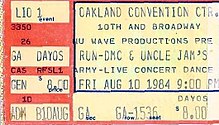
A ticket for a 1984 concert in Oakland, California
Subsequently signing with Profile Records, Run-DMC released their debut single "It's Like That/Sucker MCs", in late-1983.[xvi] The unmarried was well received, peaking at #15 on the R&B charts.[17] The trio performed the single on the New York Hot Tracks video testify in 1983. Emboldened past their success, Run-DMC released their eponymous debut album Run-D.Thousand.C. in 1984.[16] Hit singles such as "Jam-Primary Jay" and "Hard Times" proved that the group were more than than a ane-hit wonder, and the landmark unmarried "Rock Box" was a groundbreaking fusion of raw hip hop and hard rock that would become a cornerstone of the grouping's sound and paved the way for the rap rock subgenre motility of the 1990s.
Run-DMC's swift ascension to the forefront of rap with a new audio and style meant that onetime-school hip hop artists were becoming outdated. Along with pushing rap into a new direction musically, Run-DMC inverse the unabridged artful of hip hop music and civilization. Sometime school rappers similar Afrika Bambaataa and Melle Mel of Grandmaster Flash and the Furious V tended to dress in the flashy attire that was commonly attributed to glam rock and disco acts of the era: tight leather, breast-baring shirts, gloves and hats with rhinestones and spikes, leather boots, etc. Run-DMC discarded the more glam aspects of early hip hop fashion (which were afterwards readopted in 1990 past more "pop" rappers like MC Hammer and Vanilla Ice) and incorporated a more "street" sense of style such every bit Kangol hats, leather jackets, and unlaced Adidas shoes.[seven] The group'southward expect had been heavily influenced by Mizell'south ain personal way. When Russell Simmons saw Jay's flashy, yet street b-boy style; he insisted the entire group follow suit.[18] Run said later:
At that place were guys that wore hats like those and sneakers with no shoestrings. It was a very street thing to wear, extremely rough. They couldn't wear shoelaces in jail and nosotros took information technology equally a way statement. The reason they couldn't have shoelaces in jail was that they might hang themselves. That's why DMC says 'My Adidas only bring practiced news and they are not used as felon shoes.'[19]
That encompass of the look and style of the street would ascertain the adjacent 25 years of hip hop fashion.
King of Rock, Raising Hell and mainstream success [edit]

From left to right: Simmons, Mizell, McDaniels
Later on the success of their first album, Run-DMC looked to branch out on their follow-upwards. The release of King of Stone in 1985 saw the group furthering their rap rock fusion on songs similar "Can You lot Rock It Like This" and the championship runway; while "Roots, Rap, Reggae" was one of the offset rap/dancehall hybrids. The music video for the single "Rock Box" was the offset ever hip hop music video to be broadcast on MTV and received heavy rotation from the channel. The song was the group's near popular hit at that signal and the anthology was certified platinum. Run-DMC performed at the legendary Live Aid do good soon afterwards Stone Box was released.
In late-1985, Run-DMC were featured in the hip hop film Krush Groove, a fictionalized retelling of Russell Simmons' rise as a hip hop entrepreneur and his struggles to get his own label, Def Jam Recordings, off the basis.[16] The film featured a young Blair Underwood as Russell, along with appearances by former-school legend Kurtis Blow, The Fat Boys, teen pop act New Edition, LL Absurd J, Prince protegee Sheila E., and hip hop's first successful White rap group, the Beastie Boys, who were signed to Simmons' Def Jam label. The film was a hit in cinemas and was further proof of hip hop's continued mainstream visibility.
Returning to the studio in 1986, the group teamed with producer Rick Rubin for their third anthology. Rubin had only produced LL Cool J'south debut album Radio. They subsequently released their third album, titled Raising Hell, which became the grouping'due south most successful anthology and one of the best-selling rap albums of all-fourth dimension.[sixteen] The album was certified double-platinum and peaked at number iii on the charts.
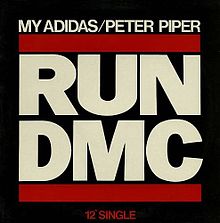
12" single cover for the group's single "My Adidas"
They were almost done with the album, but Rubin idea that it needed an element that would appeal to rock fans every bit well. This spurred the lead single "Walk This Way", a collaboration with the grouping Aerosmith, who years before had washed their original version of the classic difficult rock song on their anthology Toys in the Attic. The original intention was to just rap over a sample of the song, but Rubin and Jay insisted on doing a complete cover version. Members of the group Aerosmith (including Steven Tyler and Joe Perry) were called to join Run-DMC in the studio to add their vocals and guitars.[20] The vocal and video became one of the biggest hits of the 1980s, reaching #four on the Hot 100, and cemented Run-DMC's crossover condition. Information technology likewise resurrected Aerosmith's career.[21] The unmarried "My Adidas" led to the group signing a $1,600,000 endorsement deal with athletic apparel make Adidas. Adidas formed a long-term relationship with Run-DMC and hip hop.[22] This has been described equally the "kickoff of what nosotros accept come to know as hip hop way".[23]
The success of Raising Hell is often credited with kick-starting hip hop's golden historic period, when rap music'due south visibility, diverseness, and commercial viability exploded onto the national phase and became a global phenomenon.[xvi] Their success paved the way for acts like LL Cool J and the Beastie Boys. The grouping toured in the wake of the album's success, but the Raising Hell Tour was marred past violence, peculiarly fights between rival street gangs in places like Los Angeles. Though Run-DMC'south lyrics had been angry, confrontational and aggressive, they typically denounced crime and ignorance, but the media began to arraign the grouping for the incidents. In the wake of the violence, Run-DMC would telephone call for a day of peace between the gangs in Los Angeles.
In 1987, following on from the Raising Hell Bout, Run-D.Thou.C embarked on the Together Forever Bout with the Beastie Boys.
Tougher Than Leather, irresolute times [edit]
After spending 1987 on tour supporting Raising Hell, Run-DMC released Tougher Than Leather in 1988. The album saw the group discarding much of their rap rock leanings for a grittier, more sample-heavy sound. Despite non selling as well equally its predecessor, the anthology boasted several potent singles, including: "Run's House", "Beats to the Rhyme", and "Mary Mary." Though at the time considered a disappointing follow-up to the blockbuster Raising Hell, the album has grown in stature. In the 2000 liner notes for the album'due south re-release, Chuck D. of Public Enemy would telephone call the album "...a spectacular performance confronting all odds and expectations."[24]
Afterward in 1988, the group made their second movie appearance in Tougher Than Leather, a would-be crime caper that was directed past Rick Rubin and featured special guest performances by the Beastie Boys and Slick Rick. The flick bombed at the box office, just strengthened the indirect relationship between Run-DMC and the Def Jam characterization. Though the grouping itself was never signed to the label, they were managed past Russell Simmons, produced by Rick Rubin (who was a co-founder of Def Jam, along with Simmons), and oftentimes shared concert bout spotlight with acts on the label's roster.

Amidst the changing times and sliding sales, Run-DMC released Dorsum from Hell in 1990. The album was the worst-reviewed of their career, as the group tried to re-create itself musically with sick-advised forays into new jack swing (a then-popular style of production that sonically merged hip hop and contemporary R&B) and sometimes-preachy lyrical content. The two singles released, the anti-drug, anti-crime song "Pause" and street narrative "The Ave", had little success, and the group began to look outdated. Reeling from their first taste of failure, personal problems began to surface for the trio. McDaniels, who had been a heavy drinker in recent years, was losing control to alcoholism. Jay was involved in a life-threatening car accident and survived two gunshot wounds subsequently an incident in 1990. In 1991, Simmons was charged with raping a college student in Ohio, though the charges were later dropped.[25]
With so much personal anarchy and professional incertitude, the members turned to religion to try to steady their lives. Both Simmons and McDaniels joined the church, with Run condign especially devoted following his legal troubles and the toll it took on his finances.[26]
After a iii-yr hiatus that seemingly saw rap music motion on without them, the rejuvenated Run-DMC returned in 1993 with Downward with the King. Building on the gritty sound of Tougher Than Leather, and adding some subtle religious references, the album featured guest appearances and production by several hip hop notables (including Pete Rock & CL Smooth and Q-Tip of A Tribe Chosen Quest). Buoyed past the title track and first unmarried, the anthology entered the charts at #i and #7 on the pop charts.[21]
Fifty-fifty though the album went platinum, the vocal proved to be their last hit. Jam Main Jay also establish success on his ain; he had founded his own characterization JMJ Records, and discovered and produced the grouping Onyx, which had tremendous success in 1993 post-obit the release of their hit single, "Slam." Subsequently that same year, Run became an ordained minister, and in 1995 the iconic group appeared in The Show, a Def Jam-produced documentary that featured several of hip hop's biggest acts discussing the lifestyle and sacrifices of the industry.
Later years, Mizell'due south murder and break-up [edit]
Over the next few years, the group did very trivial recording. Mizell produced and mentored upwardly and coming artists, including Onyx and fifty Cent, who he eventually signed to the JMJ label. Simmons got divorced, remarried, and began to focus on his spiritual and philanthropic endeavors by becoming a reverend. He too wrote a book alongside his blood brother Russell.[vii] McDaniels, also married, fabricated an appearance on the Notorious B.I.Thou.'s 1997 double-anthology Life After Death, and focused on raising his family.
Though the group continued to tour around the globe, over a decade of living a rap superstar lifestyle was get-go to take a toll on McDaniels. He was beginning to tire of Run-DMC, and in that location was increased friction between him and Simmons, who was eager to return to recording (Simmons had at this time adopted the moniker Rev Run in light of his religious conversion). While on bout in Europe in 1997, McDaniels' ongoing battle with substance abuse led to a bout of severe depression, which spurred an habit to prescription drugs. McDaniels' depression continued for years, and so much and then that he contemplated suicide.[27]
In 1997, producer and remixer Jason Nevins remixed "Information technology's Catchy" and "It's Like That". Nevins' remix of "It's Similar That" hitting number 1 in the United Kingdom, Deutschland, and many other European countries. A video was made for "It's Like That", although no new footage of Run-DMC appeared in it. In 1999, Run-DMC recorded the theme song for WWF wrestling stable D-Generation 10 entitled "The Kings", which appeared on the WWF Aggression album. They as well fabricated an appearance in a rare version of the music video "Bodyrock" by Moby.
Soon after, the group finally returned to the studio, but in an increasingly tense surround, as Simmons and McDaniels' differences had begun to show. In the wake of the exploding popularity of rap-rock artists similar Korn, Limp Bizkit, and Kid Rock, Simmons wanted to render to the aggressive, hard rock-tinged sound that made the group famous. McDaniels – who had get a fan of thoughtful vocalizer-songwriters like John Lennon, Harry Chapin, and Sarah McLachlan – wanted to go in a more introspective management. Actualization on VH1's documentary serial Behind the Music in early 2000, McDaniels confirmed that he was creatively frustrated and highlighted some songs that he was recording on his own. The connected friction led to McDaniels sitting out most of the group'due south recording sessions in protestation.[ citation needed ]
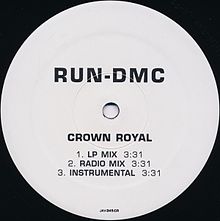
A single from Run-DMC'south final album Crown Imperial
Simmons, in defiance, recorded material anyway, inviting several invitee stars such as Kid Rock, Jermaine Dupri, Adrian Burley, Tony Fredianelli and Stephan Jenkins of Third Eye Blind, Method Man, and fellow Queens MCs Nas and Prodigy of Mobb Deep to contribute to the project. The resulting anthology, Crown Majestic, was delayed due to the personal problems, and when it was finally released in 2001, it featured but three appearances by DMC. Despite no major singles, the album initially sold well. However, many critics[ who? ] blasted the lack of DMC's interest. Some positive reviews were published: Entertainment Weekly noted that "on this hip hop roast, new schoolers Nas and Fat Joe pay their respects with sparkling grooves...Run'south rhymes are still limber."[28]
After Crown Royal, the group embarked on a worldwide tour with their "Walk This Mode" compatriots, Aerosmith. The tour was a rousing success, celebrating the collaboration between the ii acts and acknowledging the innumerable rap and rock acts that had been influenced past their seminal striking fifteen years prior.[ citation needed ] Even though he had footling to practise with the album, McDaniels was relishing the phase; he had been suffering from an inoperable vocal disorder that had rendered his once-booming voice a strained grumble. Performing allowed McDaniels to come out of his depression and he appeared revitalized on the tour. There was fifty-fifty talk of Run-DMC finally signing with Def Jam, which by then was no longer held by its original founders.[ citation needed ] Simmons, withal, had been growing increasingly tired of hip hop. His family was growing, and he was assisting with his blood brother Russell's Phat Subcontract habiliment imprint, making Run-DMC less of a priority. Despite the success of the bout and Aerosmith consequently discussing adding additional dates, Simmons abruptly announced that he was quitting.[29]
Murder [edit]
On October xxx, 2002, Mizell was shot and killed at his recording studio in Queens.[xxx] Fans and friends set up up a memorial outside the studio with Adidas sneakers, albums, and flowers. In the backwash, Simmons and McDaniels appear the official disbanding of the grouping.[31] Mizell's murder remained unsolved until August 2020, with the abort of Ronald Washington and Karl Jordan Jr.[32]
Post-breakup [edit]
In 2004, Run-DMC was one of the first acts honored on the outset annual VH1 Hip Hop Honors, alongside legends like 2Pac and The Sugarhill Gang. The Beastie Boys paid tribute. Simmons did non nourish the show; he was recording his first solo album, Baloney. McDaniels also released a solo anthology, Checks Thugs and Stone due north Whorl. He had recently discovered that he was adopted, which led him to be the eye of the VH1 program My Adoption Journey, a documentary chronicling his re-connection with his biological family. McDaniels was likewise featured in the 2008 video game, Guitar Hero: Aerosmith, making appearances in the songs "Walk this Manner" and "King of Stone". He ofttimes contributed to VH1 programs such as the I Love The... series, and he released the song "Rock Evidence" featuring singer Stephan Jenkins. Simmons likewise turned to television, starring in Run's Business firm, a reality testify that followed his life as a father and married man.
In June 2007, McDaniels appeared with Aerosmith performing "Walk This Way" for their encore at the Hard Rock Calling festival in London. Simmons joined Kid Stone'south 2008 Stone Northward Ringlet Revival Bout, performing "It's Similar That", "It'south Catchy", "Yous Be Illin'", "Run's House", "Here Nosotros Go", "King of Stone" and "Walk This Way" with Kid Stone. They besides covered "For What Information technology's Worth" at the stop of the show. In 2007, Mizell's wife, Terry, Simmons, and McDaniels also launched the J.A.M. Awards in Jay's retentivity. Jay's vision for social Justice, Arts and Music was promoted by many recording artists, including Snoop Dogg, LL Absurd J, Raekwon, Jim Jones, Chiliad.O.P., Papoose, Everlast, DJ Muggs, Kid Capri, De La Soul, Mobb Deep, EPMD, Dead Prez, Biz Markie and Marley Marl. In Oct 2008, Mizell'southward one-fourth dimension protege fifty Cent announced plans to produce a documentary about his fallen mentor.[33] In 2008 Run-DMC was nominated for 2009 induction into the Rock and Roll Hall of Fame.
On January 14, 2009, it was confirmed that Run-DMC would be i of the 5 inductees to the Stone and Roll Hall of Fame.[34] On April iii, 2009, Run-DMC became the second rap deed to be awarded the award (after Grandmaster Wink and the Furious V, who were inducted in 2007).[35] The group reunited at Jay-Z's Made In America Festival in September 2012. Simmons and McDaniels then reunited once again for Fun Fun Fun Fest in Austin, Texas in Nov 2012, and once more in June 2013 and August 2014 for summertime concerts in Atlanta, Georgia.[36]
Following the success of Notorious, it was announced in 2009 that a Run-DMC biopic was in the works, with the screenplay by Notorious writer Cheo Hodari Coker. The film was rumored to depict the life and story of the group beginning from their inception in Hollis, Queens, and leading upwardly to the 2002 murder of Jam Master Jay.[37] Even so, the project has notwithstanding to get into product.
Legacy [edit]
Stephen Thomas Erlewine, editor of AllMusic, has written: "More than any other hip hop grouping, Run-D.M.C. are responsible for the sound and style of the [hip-hop] music."[38] Musically, they moved hip hop and rap music abroad from the funk and disco-oriented sound of its beginnings, into an altogether new and unique sonic imprint. Their sound is directly responsible for intentionally transforming rap music from dance-and lodge-oriented funk grooves similar "Rapper's Delight" and "The Breaks" to an aggressive, less-danceable approach. Characterized by thin, hard-hitting beats—every bit typified on hits like "It'southward Like That", and "Peter Piper"—this would form the foundation of hardcore hip hop (especially hardcore East Coast hip hop). Equally such, Run-DMC is considered the originators of the mode, and hardcore hip hop would dominate the next ii decades of rap music, from the bombastic, noisy sound of Public Enemy and stripped minimalism of Boogie Downwardly Productions to the thump of early on Wu-Tang Association and Nas. Their influence was non limited to the E Coast, however. Los Angeles' N.Westward.A, on their landmark 1988 album Directly Outta Compton, showed heavy influences from Tougher Than Leather-era Run-DMC, and Chicano rap human action Cypress Hill were definitely influenced by Run-DMC'south fusion of rap and rock.
Rap rock fusion proved to be influential amongst rock artists, with 1980s bands like Faith No More than, and Red Hot Chili Peppers adding elements of rap to alternative rock and heavy metallic. Most notably, the rap stone genre became popular in the late 1990s, with bands like Urban Dance Squad, Rage Against the Motorcar, KoRn, Child Rock, Limp Bizkit, and Linkin Park. Aesthetically, they changed the way rappers presented themselves. Onstage, erstwhile schoolhouse rappers had previously performed in flashy attire and colorful costumes, typically had a live band and, in the case of acts like Whodini, had groundwork dancers. Run-DMC performed with merely Run and DMC out front, and Jam-Master Jay on the turntables behind them, in what is now considered the 'archetype' hip hop stage setup: two turntables and microphones. They embraced the expect and style of the street by wearing jeans, lace-less Adidas sneakers, and their trademark black fedoras. The group shunned both the over-the-top wardrobe of previous rap stars similar the Furious Five and Afrika Bambaataa, and the silk-shirted, jheri curled, ladies' man wait of rappers like Kurtis Blow and Spoonie Gee. Followers of their fashion included LL Cool J and the Beastie Boys; seemingly overnight, rappers were wearing jeans and sneakers instead of rhinestones and leather outfits. From Adidas tracksuits and rope chains to baggy jeans and Timberland footwear, hip hop's look remained married to the styles of the street. According to the Rolling Stone Encyclopedia of Rock & Scroll:
Run-D.K.C. took hardcore hip-hop from an hush-hush street awareness to a popular-civilisation phenomenon. Although earlier artists, such equally Grandmaster Flash and The Sugarhill Gang, made rap's initial strides on the airwaves, information technology was Run-D.Grand.C. that introduced hats, gold bondage, and untied sneakers to youth civilisation's almost stubborn demographic grouping: immature white male suburban stone fans. In the procedure, the trio helped modify the course of popular music, paving the manner for rap'south second generation.[17]
In 2004, Rolling Rock ranked them number 48 in their listing of the "100 Greatest Artists of All Fourth dimension".[iii] In 2007, Run-DMC was named "The Greatest Hip Hop Group of All Time" by MTV.com and "Greatest Hip Hop Artist of All Time" past VH1.[9] [8] In 2009, Run-DMC became the second hip hop group to exist inducted into the Stone and Roll Hall of Fame.[39] In 2016, Run-DMC received the Grammy Lifetime Accomplishment Award.[eleven]
Historically, the group accomplished a number of notable firsts in hip hop music and are credited with beingness the act near responsible for pushing hip hop into mainstream popular music, initiating its musical and creative evolution and enabling its growth equally a global phenomenon. Run-DMC is the showtime rap act to accept reached a number of major accomplishments:[twoscore]

Adidas sneakers with the Run-DMC logo
- A No. one R&B charting hip hop album
- The second hip hop act to appear on American Bandstand (the Sugar Hill Gang appeared first on the programme in 1981)
- The beginning hip hop deed to chart in the Top forty of the Billboard Hot 100 more than in one case
- The first hip hop creative person with a Top x pop charting rap album
- One of the offset hip hop artists with Gilded, Platinum, and multi-Platinum albums
- The beginning hip hop act to appear on the cover of Rolling Stone magazine
- One of the first hip hop acts to receive a Grammy Award nomination
- The commencement hip hop deed to make a video appearance on MTV
- The starting time hip hop act to perform at a major arena
- Signed to a major product endorsement deal (Adidas)
- The second hip hop deed to be inducted into the Rock and Ringlet Hall of Fame (the first being Grandmaster Flash and the Furious V)
Discography [edit]
- Run-D.M.C. (1984)
- Rex of Stone (1985)
- Raising Hell (1986)
- Tougher Than Leather (1988)
- Back from Hell (1990)
- Down with the Rex (1993)
- Crown Imperial (2001)
Filmography [edit]
- Krush Groove (1985)
- Big Fun in the Big Town (1986)
- Tougher Than Leather (1988)
- Who'southward the Man? (1993)
- Lip Sync Battle (2015) – Episode: "Joseph Gordon-Levitt vs. Anthony Mackie"
Music videos
- Rock Box (1984)
- King of Rock (1985)
- You Talk Too Much (1985)
- It'southward Catchy (1986)
- My Adidas (1986)
- Proud to Be Black (1986)
- Walk This Mode (feat. Aerosmith) (1986)
- Mary, Mary (1988)
- Beats to the Rhyme (alive) (1988)
- Christmas in Hollis (1988)
- Run'south Business firm (1988)
- Pause (1989)
- Ghostbusters (1989)
- The Ave. (1990)
- Faces (1991)
- Christmas Is (1992)
- Downwards with the Male monarch (1993)
- Ooh, What'cha Gonna Exercise (1993)
- Praise My DJ's (feat. Justine Simmons) (1999)
- The Kings [D-Generation X] (2000)
- Allow's Stay Together (Together Forever) (feat. Jagged Edge) (2001)
- Rock Show (featuring Stephan Jenkins) (2001)
References [edit]
- ^ Augustin Thousand. Sedgewick (November half dozen, 2002). "Run-D.M.C. Call It Quits". RollingStone. Retrieved April 9, 2015.
- ^ "Run-D.Yard.C." Rock and Gyre Hall of Fame. Retrieved September 12, 2019.
- ^ a b c d "Music News: Latest and Breaking Music News". Rolling Rock. Archived from the original on May 21, 2006. Retrieved September 29, 2013.
- ^ "Run-D.M.C. Chart History". Billboard . Retrieved November 30, 2019.
- ^ Dreisinger, Baz (February thirteen, 2019). "Run-DMC, Aerosmith and the Song That Inverse Everything". The New York Times. ISSN 0362-4331. Retrieved Nov 30, 2019.
- ^ Together Forever: Greatest Hits 1983–1991 (Meaty disc liner). Run-D.M.C. New York, New York: Profile Records. 1991. PCD-1419.
{{cite AV media notes}}: CS1 maint: others in cite AV media (notes) (link) - ^ a b c Winning, B (November 2006). "Run-DMC: 'It's similar that". REMIX, Electronic • Urban. 8 (11).
- ^ a b "MTV News: The Greatest Hip-Hop Groups Of All Time". Mtv.com. March 9, 2006. Retrieved December 7, 2009.
- ^ a b "VH1: 50 Greatest Hip Hop Artists". Rock On The Net. Retrieved December 7, 2009.
- ^ "Run-DMC". Rock and Roll Hall of Fame . Retrieved January 21, 2018.
- ^ a b Legaspi, Althea (Jan 14, 2016). "Run-D.M.C. to Receive GRAMMY Lifetime Accomplishment Award". Rolling Rock . Retrieved March 13, 2019.
- ^ "National Recording Registry Reaches 500 [MARCH 21, 2018]". loc.gov . Retrieved May ane, 2019.
- ^ a b "Run DMC Biography". OldSchoolHipHop.com.
- ^ Weiner, Jonah. "Run-DMC Record 'It'due south Like That/Sucker MCs'" Archived June 30, 2006, at the Wayback Machine, Blender, 15 September 2004.
- ^ "What Does RUN-D.Thou.C. Stand For?". Classic HIP HOP Mag . Retrieved December 1, 2019.
- ^ a b c d east Colin Larkin, ed. (1997). The Virgin Encyclopedia of Popular Music (Concise ed.). Virgin Books. pp. 1044/v. ISBNone-85227-745-9.
- ^ a b "Biography of Run-DMC". Rolling Stone.com . Retrieved February xi, 2015.
- ^ Vineyard, Jennifer (Nov 4, 2002). "DMC Speaks On Jam Master Jay'due south Function In The Run-DMC Legacy". MTV.com. Retrieved December seven, 2009.
- ^ Run DMC Slammed The 1980s
- ^ "Walk This Style by Uncovering the Embrace • A podcast on Anchor". Anchor . Retrieved April ten, 2020.
- ^ a b "Hall of Fame: Run-DMC bring rap to the masses". REMIX, Electronic • Urban.
- ^ "Adidas Promotes Shoes With Run DMC Clemency". BizBash.com . Retrieved December 7, 2009.
- ^ Romero, Elena (2012). Free Stylin': How Hip Hop Changed the Fashion Industry. ABC-CLIO. ISBN978-0-313-38646-6 . Retrieved January 20, 2020.
- ^ "HIPHOPINJESMOEL – "Tougher Than Leather" Liner Notes by Chuck D". Hiphopinjesmoel.com. Archived from the original on July 2, 2007. Retrieved December seven, 2009.
- ^ Pringle, Gill. "Reverend Run: Pray this style", The Independent, 7 June 2006.
- ^ Millner, Denene. "He'southward Rev. Run — For His New Life Rapper's Please At present Religion", New York Daily News, 10 October 2000.
- ^ Wells, Christina. "'DMC: My Adoption Journey' Documentary Nominated for Emmy Award" at his official website, 25 July 2007.
- ^ Browne, David. "Music Capsule Review: Run-DMC: Crown Royal (Arista)", Entertainment Weekly, half dozen April 2001, p.120.
- ^ Ro, Ronin (October 18, 2005). Raising Hell: The Reign, Ruin, and Redemption of Run-D.M.C. and Jam Master Jay. ISBN9780060781958.
- ^ "Run-DMC DJ slain in recording studio - Nov. 1, 2002". CNN.com. Retrieved September 29, 2013.
- ^ McShane, Jamie; Murphey, Chris (November half dozen, 2002). "Surviving Run-DMC members retire grouping". CNN. Archived from the original on November 5, 2007. Retrieved November 6, 2002.
- ^ Ashley Southall, Mihir Zaveri, and Alan Feuer (August 17, 2020). "2 Are Charged in Killing of Jam Master Jay, Hip-Hop Pioneer—The two men had long been suspects in the 2002 killing of the D.J., a member of the grouping Run-DMC". The New York Times . Retrieved August 17, 2020.
{{cite news}}: CS1 maint: multiple names: authors list (link) - ^ Jason. "50 Cent Produces Jam Master Jay Documentary", rapbasement.com, 28 Oct 2008.
- ^ Vozick-Levinson, Simon (January 14, 2009). "Rock and Roll Hall of Fame inductees '09: Metallica, Run-D.One thousand.C., and more than". Amusement Weekly . Retrieved February 11, 2015.
- ^ Rock Hall Nominations, The states Today, 22 September 2008.
- ^ "Braves Summer Concert Series - Run DMC | braves.com: Tickets". Atlanta.braves.mlb.com. May 24, 2013. Retrieved September 29, 2013.
- ^ "Run-DMC Biopic Heading to the Big Screen With Assist of Notorious Writer | Music News". Rolling Rock. January 29, 2009. Retrieved September 29, 2013.
- ^ Erlewine, Stephen Thomas. Run-D.M.C. Biography at Allmusic.com
- ^ "Run-DMC". Rock and Roll Hall of Fame . Retrieved January 21, 2018.
- ^ "Run-DMC". Jan 29, 2009. Archived from the original on January 29, 2009.
Notes [edit]
- Appiah, Kwame Anthony and Gates, David Turner Arts and Letters: An A-to-Z Reference of Writers, Musicians, and Artists of the African American Experience. Running Press: Philadelphia: 2004. ISBN 0-7624-2042-1
Further reading [edit]
- Adler, Bill (1987). Tougher Than Leather: The Authorized Biography of Run-DMC. New American Library. ISBN0965653560.
- Brown, Terrell, "Reverend Run (Run-DMC)," Mason Crest Publishers, 2008.
- Joseph Simmons, Daryl McDaniels and Amy Linden,"Niggas With Approbation," Transition, 1993
- McDaniels, Darryl (with Haring, Bruce), "Rex of Rock: Respect, Responsibility, and My Life with Run-DMC," Thomas Dunne Books/St. Martin's Printing, 2001.
- Reverend Run, The (with Taylor, Curtis 50.), "It's Like That: A Spiritual Memoir," St. Martin's Press, 2000.
- Ro, Ronin, "Raising Hell: The Reign, Ruin, and Redemption of Run-DMC and Jam Master Jay," Amistad, 2005.
- Thigpen, David E. (2003). Jam Master Jay: The Eye of Hip-Hop. Pocket Books. ISBN0743476948.
External links [edit]
 | Wikimedia Eatables has media related to Run–D.M.C.. |
- Official website
- Run-DMC at Curlie
- Run-DMC discography at Discogs
- Epitome of Run-DMC'south Joseph "Run" Simmons and Darryl "D.M.C." McDaniels performing in Long Beach, California, 1984. Los Angeles Times Photographic Archive (Collection 1429). UCLA Library Special Collections, Charles East. Young Research Library, University of California, Los Angeles.
Source: https://en.wikipedia.org/wiki/Run-DMC
0 Response to "Va-jezzy Mel Rock - Im Back Again"
Post a Comment